
11 Plus Exam UK: Complete Preparation Guide
The 11 Plus is a selective entrance exam used by grammar schools and some independent schools to decide who gets a place in Year 7. For many families, this is the first big academic hurdle, and the best way to deal with it is clear information, early preparation, and steady, calm practice.
This guide brings together all the information in one place about the exam format, the subjects, timelines, how to prepare, tutoring options, scoring, advice for the day of the exam and next steps.
If you need practical advice on how you can help your child through the process, check out our guide to how parents can support their child with the 11+ and SATs.
1. What Is the 11 Plus Exam?
The 11 Plus is a selective exam taken by UK grammar schools and some independent schools to decide who gets into Year 7.
It’s usually taken in Year 6, when children are 10 or 11. It’s not about testing one fixed curriculum, but about assessing core skills, problem solving and critical thinking, so strong foundations matter more than rote learning.
The test is not the same everywhere. Different schools and local authorities use different formats, subjects and pass marks, and the papers are set by a variety of providers, most notably GL Assessment and CEM (the Centre for Evaluation and Monitoring).
Some independent schools do their own. Be sure to find out which version your child’s schools use before you begin to prepare.
2. When is the 11 Plus and How to Apply?
Exam date: Most 11 Plus exams are taken in early Autumn (usually September) at the start of Year 6, although the exact date will depend on the school and local authority.
Registration: Registration usually takes place in Year 5 or early Year 6 (generally between April and June) either through your local council or directly with the grammar school. Many schools have online registration. Please note deadlines early, as late entries are generally not accepted.
Results: Generally released a few weeks after the exam (usually in October), but dates vary.
Typical timeline:
Stage | Typical timing |
Registration opens | April |
Registration closes | June |
Exam | September (Year 6) |
Results | October |
3. What subject matter is covered?
Most 11 Plus exams test a mixture of four areas. Some schools test all four; some test two or three.
English: reading comprehension, grammar, punctuation, spelling and vocabulary. A strong vocabulary also helps with verbal Reasoning and with following instructions accurately. Some schools add a short creative writing task.
Maths: arithmetic, fractions, percentages, ratios, basic algebra, word problems and logic. It tests core skills and problem-solving. Speed is important but only if you are accurate.
Verbal Reasoning: relationships and patterns in words and letters, for example word sequences, codes, analogies and synonyms and antonyms.
Non-Verbal Reasoning: diagrams, shapes and spatial puzzles. It tests how a child thinks rather than what they know. Many children find it strange at first.
Science (some schools only): Mostly independent schools. Expect KS2-level biology, chemistry and physics, scientific vocabulary and simple experiments.
These subjects also develop skills for secondary school. English develops reading, writing, and communication skills. Maths develops logical thinking.
Reasoning develops problem-solving skills across all subjects. Our 11+ Entrance Exams program addresses each of these areas.
4. 11 Plus Exam Format: Papers, Questions and Timing
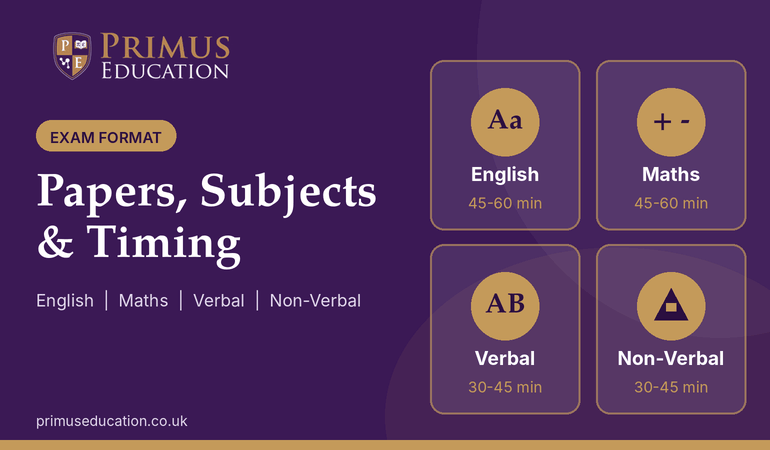
Children typically sit two to four papers, with English and Maths as the core. Formats vary by school and exam board, but you can generally expect:
Paper | Typical length | Typical question types |
English | 45–60 minutes | Comprehension, grammar, vocabulary, spelling |
Maths | 45–60 minutes | Number, word problems, reasoning |
Verbal Reasoning | 30–45 minutes | Sequences, codes, analogies |
Non-Verbal Reasoning | 30–45 minutes | Patterns, shapes, spatial puzzles |
- Number of questions: roughly 30–80 per paper, depending on the board and school.
- Style: mostly multiple choice, with some short written answers (especially in English) and diagram-based questions.
- Time pressure: more questions at the same time means less time per question, so pacing is essential. Practising under timed conditions is one of the most effective ways to improve.
5. How Difficult is 11 Plus?
It is supposed to be difficult, both academically and emotionally. Common reasons children do not do well:
Time pressure: lots of questions to answer quickly.
Advanced content: complex vocabulary, tricky logic and Reasoning that’s not always covered in school lessons.
High competition: A limited number of places, so only the highest scorers get offered a seat.
Unfamiliar conditions: children are not familiar with formal exam settings or styles of reasoning questions.
Even bright kids can feel overwhelmed without preparation. It’s not a question of ability, but experience, and that’s exactly what good preparation addresses. Here, tuition for dedicated 11+ Entrance Exams can be extremely beneficial in providing professional guidance.
6. Why It Matters to Prepare
The point of getting started early is not to work harder, but to work smarter. Good preparation enables children to:
- Learn new types of questions gradually and build up your skills step by step.
- Learn the exam format and conditions so that you can be less anxious.
- Practise exam technique: read carefully, manage your time, skip and return, check answers.
- Make mistakes early, learn from them, and avoid last-minute stress.
- Even if the child does not end up sitting the test or gaining a selective place, build confidence, concentration, study habits, and problem-solving skills that will last well beyond the exam.
7. When to start preparing?
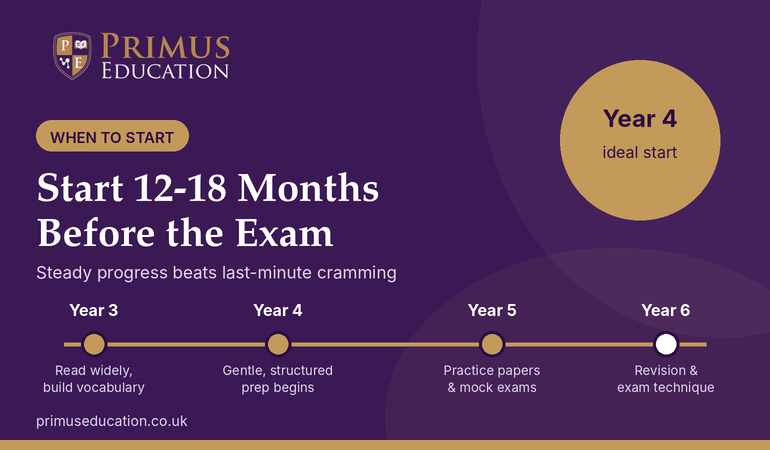
Most experts recommend starting 12-18 months before the exam, which, for most children, means Year 4 or early Year 5. Better than cramming at the last minute, make steady, consistent progress.
- Year 3: keep it light. Read a lot, build your vocabulary, and get a strong foundation in maths.
- Year 4: gentle, structured preparation: puzzles, problem solving and introduction to 11 Plus question styles. Teach fundamental ideas in Maths and English.
- Year 5: intensive preparation: regular practice papers, timed tests and mock exams to improve speed and confidence.
- Year 6 (final few months before the exam): revision, time management, and exam technique. Practice under timed conditions to simulate real exam pressure.
Is it ever too late? No. With less than a year to go, a focused, structured plan and targeted studying can still bring about significant improvements.
Starting earlier than Year 4 may be beneficial where children need more time to build core skills—planning for the months to come? Read about the cost of 11+ exam preparation.
8. How to Prepare for the 11 Plus: Step by Step
- Assess: Take a baseline test to see where you are strong and where you are weak.
- Plan: Create a realistic schedule that divides the syllabus into manageable sections and incorporates study sessions, tuition (if necessary), breaks and relaxation.
- Learn: Use focused resources such as grammar school preparation books (Bond, CGP, First Past the Post, Schofield & Sims, GL Assessment), as well as apps and online platforms designed for 11 Plus subjects.
- Practice: work on past papers and practice questions regularly. As the exam approaches, try to do at least one timed paper a week.
- Review: go through each mistake, learn why the answer was correct or incorrect, and revise the plan. Writing the paper is as valuable as the guided review.
- Concentrate on the weak spots: Spend more time on the areas your child finds difficult, especially the ones that are worth more or have been troublesome in the past. Don’t just practise strengths.
- Do practice tests: try to do at least three full-length ones to get used to the time constraints, to build up your stamina, to reduce test anxiety and to see how you are progressing.
- Final prep: last week, ease up on intense study and do light revision to keep stress low and confidence high.
- Practice time management:Encourage your child to use a timer or stopwatch while practising so that they can estimate how much time to spend on each question.
- Common mistakes to avoid are:cramming too much at once, neglecting time management, only practising strengths and ignoring weaker areas, and practising without exam conditions.
9. Getting Ready for the 11 Plus at Home
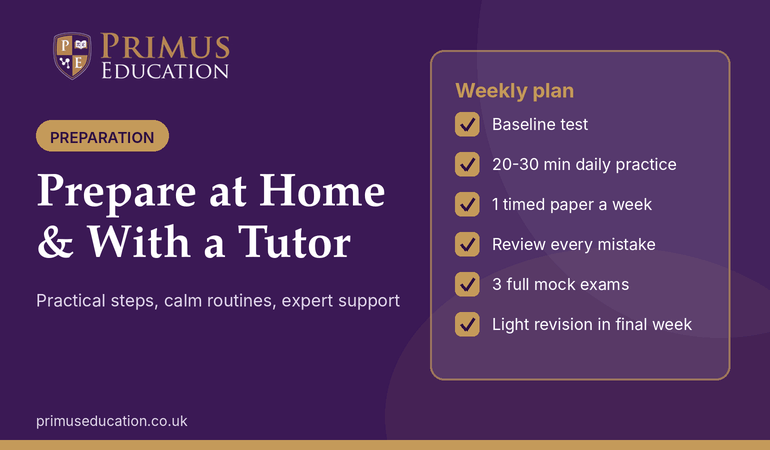
Parents don’t have to be experts. The simple, consistent support goes a long way. Read our guide on how parents can help their child with the 11+ and SATs to find out more.
- Have a place to study: It should be quiet, well-lit, distraction-free, and stocked with pencils, paper, and books.
- Make sessions short and regular: 20-30 minutes a day is more effective than last-minute cramming.
- Combine resources: books, online practice and past papers to cover all aspects of the exam.
- Build reading and maths habits: Encourage regular reading and maths practice.
- Make it fun: word games, puzzles, flashcards and educational apps keep learning interesting.
- Schedule breaks and rest: If you study too much without breaks, you will get burnt out.
- Set realistic goals: break down larger goals into smaller tasks so it’s easy to see progress.
- Think positive: compliment effort rather than perfection, celebrate small successes, discuss errors calmly, and consider small rewards (like a fun outing) for steady effort. Children who feel supported and not judged grow in confidence.
- Reinforce understanding: Get your child to explain things back to you. This will quickly show up gaps.
10. Do You Need An Eleven Plus Tutor?
11 Plus tutoring is a special preparation for the entrance exam, usually for children aged 10-11. It develops core skills in Maths, English, Verbal and Non-Verbal Reasoning, and teaches exam strategy.
A tutor is helpful but not compulsory: some children pass without tuition, but many benefit from structured support, especially if they feel unsure or anxious, or are falling behind the syllabus. Take a look at our 11+ Entrance Exams tuition to see how it works in practice.
Self-study vs tuition:
Approach | Pros | Cons |
Self-study | Affordable and flexible | Needs discipline; gaps in knowledge and lack of structure |
Tuition | Structure, expert guidance, instant feedback, accountability, targeted strategies | Can be more expensive |
If your child is struggling with core subjects, needs some structured practice, is unmotivated or falling behind – consider a tutor. Tutoring at home by parents can help, but an experienced tutor is often the safer route, as too much pressure or the wrong techniques can backfire.
When to start tutoring: It is contingent upon your child’s readiness, the competitiveness of your target schools and their requirements. You can start light preparation around age 9, and ideally you want to start about 18 months before the exam. If you begin early, you can gradually build your skills, knowledge and confidence.
How tutoring aids:
- Identifies strengths and weaknesses and offers targeted support.
- Teaches the right techniques at the right time, which increases the chances of success.
- Boosts confidence, time management and exam strategy.
- Works best with a clear plan. Without it, any extra study can feel like pressure.
What a good program covers: Maths (problem-solving, arithmetic, reasoning); English (comprehension, grammar, creative writing, vocabulary); Verbal Reasoning (word patterns, logic); Non-Verbal Reasoning (spatial awareness, pattern recognition); exam techniques (time management and answering strategies); and assessment (regular progress tracking, past papers, timed practice and mock exams).
Kinds of tuition:
- One-to-one: highly personalised lessons to suit your child’s pace, strengths and weaknesses.
- Group sessions: A dynamic environment with collaboration, peer interaction and healthy competition.
- Online: perfect for busy families or locations where quality tutors are hard to find.
- In-person: Creates a better student-tutor relationship and offers more hands-on help.
Families who speak another language at home: bilingual and multilingual children can perform very well in the 11 Plus. While English papers may seem harder at first, regular reading, vocabulary building, comprehension practice, and a tutor who understands bilingual learning strategies can help to bridge the gap. Bilingualism is not to be considered a handicap.
How to choose the right tutor: Find someone who knows the 11 Plus exam, has experience with past papers, can create a personalised plan and is patient and encouraging.
Check their qualifications, track record and reviews. Ask how tutors tailor lessons to your child’s strengths and weaknesses. Think about online versus in-person, and group versus one-to-one, depending on your child’s and family’s schedule.
Many families also factor in the cost of 11 Plus tuition when planning support in the months leading up to the exam. Our breakdown of the costs of preparing for the 11+ exam may help.
Balancing school and tutoring: Create a consistent schedule that has time for homework, rest and play. Maintain open communication between the tutor and the school teachers, and ensure your child gets enough sleep, nutritious food, and exercise. Teach them that mistakes are a part of learning and recognise every small improvement.
11. Effective Exam Techniques
- Read the questions and instructions carefully before answering.
- By eliminating wrong answers from multiple-choice questions, you increase the likelihood of picking the right one.
- Skip and return: Don’t get stuck on tricky questions; come back if time permits.
- In reasoning papers, look for patterns, sequences, and logic.
- Go over answers: check your work and Reasoning to find small mistakes.
- Take mock exams to develop your stamina, pacing and accuracy.
- Introduce timed practice gradually so that the children understand the questions before the focus shifts to speed.
12. How the 11+ is Marked
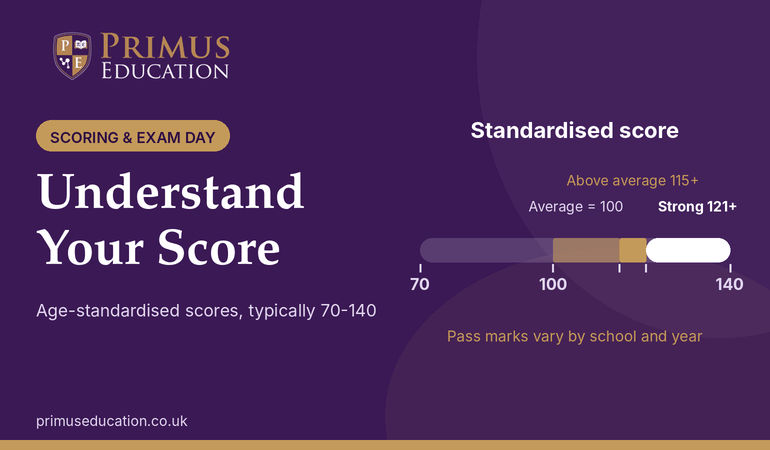
Papers are marked using raw marks, which are then age-standardised to ensure younger children (e.g. those with birthdays close to the exam) are marked fairly against older ones.
Standardised scores typically range from 70 to 140, with 100 being the average.
- Above 115: above average
- 121 or higher: strong performance
There is no one “pass mark”. Thresholds vary by school, region and year, and some areas rank children and give places to the highest scorers.
Examples of how different this can be: last place offered at the Kent Test (2023) was 332 (total across papers), Birmingham grammar schools around 224, and Medway selects about the top 25% of pupils.
These change each year, so always check each school’s current requirements. Where places are limited and/or further selection criteria are applied, meeting the qualifying standard does not guarantee admission.
13. What to Expect on Exam Day
Logistics: Be sure your child knows the venue, start time and what to bring, such as pencils, erasers, rulers, a watch (if permitted), water and anything else specified by the school. Check identification or documentation requirements.
The night before and morning of: a good night’s sleep, a healthy breakfast and arriving on time. Don’t introduce new topics at the last minute.
Mindset: Remind your child that they have prepared, that the exam is just a part of their academic journey, and that the most important thing is to do their best.
Encourage them to stay calm, skip the hard questions for now and come back to them later, and check their answers if time allows. For more on how to keep your child calm and confident, see how parents can help their child.
14. What If Your Kid Fails?
Resits are typically not permitted, as most schools only allow one attempt per admissions cycle. Other possibilities are:
- If your child is close to the pass mark, appeal the result (check the school’s appeals process).
- Independent schools with their own entrance tests.
- Late entry exams in Year 8, if offered.
- Other secondary routes which might suit your child better.
There are many routes to success beyond the 11 Plus, and the skills your child will develop in preparation, such as concentration, resilience and problem-solving, will serve them throughout their education.
15. Frequently Asked Questions
Is the 11 Plus the same everywhere?
No. Format, subjects and pass marks vary between schools and local authorities, and papers come from different providers such as GL Assessment and CEM.
What subjects are in the 11 Plus?
Most include English and Maths. Many also test Verbal and Non-Verbal Reasoning, and a few independent schools include Science. Check your chosen schools.
When should my child start preparing?
Most children start in Year 4 or early Year 5, with light preparation first and more focused practice in Year 5. Starting later can still work with a structured plan.
How long is the 11 Plus and how many questions are there?
Papers typically last 30–60 minutes each, with roughly 30–80 questions per paper, mostly multiple choice.
How difficult is the 11 Plus?
It is designed to be challenging, but it tests thinking skills as well as school knowledge. Regular practice and good guidance make a significant difference.
Can my child pass without tutoring?
Some do, but many benefit from structured support that teaches question styles, time management and how to avoid common mistakes. You can see what support looks like in our 11+ Entrance Exams programme.
What is a good 11 Plus score?
On a standardised scale with an average of 100, scores above 115 are above average and 121+ is strong. The score needed for a place varies by school, so check each school’s requirements.
Can children resit the 11 Plus?
Usually not. Most grammar schools allow one attempt per admissions cycle.
When are results released?
Usually a few weeks after the exam, often in October, though dates vary by school and local authority.
How can parents support their child?
Create a consistent routine, keep sessions short and positive, encourage effort over perfection and focus on progress rather than perfection. Our guide on how parents can support their child with the 11+ and SATs has more practical tips.
Does tutoring put too much pressure on my child?
Not when it is well planned. A balanced programme builds understanding and confidence without overwhelming your child. Keep sessions short, celebrate progress and keep talking to them about how they feel.
Should I choose one-to-one or group tuition?
One-to-one tuition is tailored to your child’s pace, while group sessions add collaboration and healthy competition. The right choice depends on your child’s learning style and needs.
Can bilingual children succeed in the 11 Plus?
Yes. Regular English reading, vocabulary work, comprehension practice and a tutor experienced with bilingual learners make a big difference.
Is the best age to begin tutoring 9 or 10?
Light preparation from around age 9 can help, and about 18 months before the exam is ideal. The right time depends on your child and your target schools. For budgeting, see how much it costs to prepare for the 11+ exam.
Where can I find 11 Plus tuition in Manchester?
Primus Education provides 11 Plus preparation in Old Trafford, Manchester, with small-group tuition delivered by fully qualified teachers across English, Maths, Verbal Reasoning and Non-Verbal Reasoning. Learn more about our 11+ Entrance Exams programme.