

All Year 6 pupils in England take KS2 SATs at the end of primary school. They tell teachers what children know in English and maths, give them a true picture of where children are, and help secondary schools plan the support pupils need from day one.
The run-up to SATs week can be a confusing and stressful time for parents. In this guide, we cover what the tests are, why they are important, when they take place, how scores are calculated and how you can help your child prepare with confidence, not pressure.
What Are KS2 SATs?
KS2 SATs (Key Stage 2 Standard Assessment Tests) are national tests taken by Year 6 pupils (aged 10 or 11) in England.
The government sets them to measure how well children have learnt the national curriculum in the core subjects of English reading, English grammar, punctuation and spelling (GPS) and maths.
“It’s not a pass/fail test. They are a snapshot of where a child is at the end of primary school, and teachers, schools, and secondary schools use them to understand a pupil’s strengths and where they might need extra support.
What Does Key Stage 2 Mean?
Key Stage 2 Years 3- 6 Primary education, second phase in England.
- Year 3 – 7- 8-year-old children
- Year 4 – Ages 8–9
- Year 5 – Ages 9 – 10
- Year 6 – 10-11 years of age
SATs are taken right at the end of this stage, so they reflect 4 years’ work rather than a single term’s work.
These are the years when children learn vital skills in English, maths, science and other subjects, and SATs help teachers to understand if pupils are prepared for the academic demands of secondary school.
Who Sits KS2 SATs?
All state-maintained primary school Year 6 pupils in England take the KS2 SATs. Independent and private schools do not have to enter pupils for the exams, although some do for internal benchmarking or to monitor progress.
The official timetable from the Standards and Testing Agency says most pupils will sit the tests in the same assessment week in May.
Schools can put in place appropriate provisions for pupils with special educational needs or disabilities, including approved access arrangements where appropriate.
What Subjects and Papers Are Included?
Pupils sit six papers across four days, covering three subject areas:
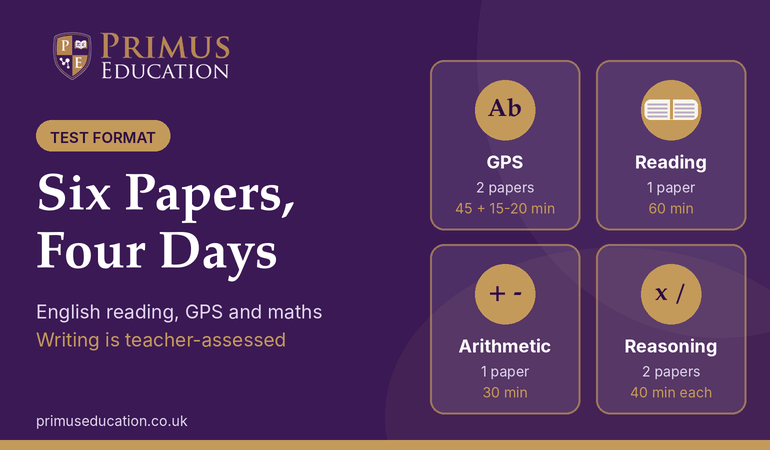
| Subject | Papers | Typical duration |
| English grammar, punctuation & spelling (GPS) | 2 (grammar and punctuation paper, spelling paper) | 45 mins + 15–20 mins |
| English reading | 1 | 60 mins |
| Maths arithmetic | 1 | 30 mins |
| Maths reasoning | 2 | 40 mins each |
English writing is assessed by teachers across the year rather than through a timed test.
Science is also teacher-assessed, but a small sample of schools could be asked to run optional science sampling tests as part of national monitoring.
SATs are about English and maths because these are the foundation for all future learning.
What Each Paper Tests
English reading: understanding main ideas in a text, inferring meaning and explaining answers, identifying key details and vocabulary, understanding unfamiliar words using context, supporting answers with evidence from the text, and understanding the writer’s purpose and structure of a passage.
GPS: Using language rules: correct grammar and punctuation; correct spelling; nouns, verbs, adjectives and adverbs; sentence structure and types; verb tenses and subject-verb agreement; commas, apostrophes and other punctuation; direct speech and reported speech; prefixes, suffixes and spelling patterns
Maths arithmetic: Adding, subtracting, multiplying and dividing; fractions, decimals and percentages; and written calculation methods.
Maths reasoning: Applying maths skills to solve problems and explain thinking. Common topics include fractions, decimals and percentages; measurement and conversions; geometry and properties of shapes; statistics and data interpretation; number sequences and place value; and multi-step word problems.
Each paper has a time limit, so children have to work carefully and efficiently.
When Do KS2 SATs Take Place?
KS2 SATs are sat over four days in mid-May, normally with the English papers first and the two maths reasoning papers toward the end of the week.
Exact dates shift slightly from year to year, so always check GOV.UK use the official timetable for the current year rather than dates from last year.
Schools get the confirmed timetable well in advance from the Standards and Testing Agency, and most pass it on to parents in the spring term.
For reference, the 2027 assessment period is scheduled as follows:
| Date | Assessment |
| Monday 10 May 2027 | English Grammar, Punctuation and Spelling |
| Tuesday 11 May 2027 | English Reading |
| Wednesday 12 May 2027 | Mathematics Arithmetic and Reasoning Paper 1 |
| Thursday 13 May 2027 | Mathematics Reasoning Paper 2 |
Are KS2 SATs Compulsory?
Yes. SATs are statutory for pupils in state-maintained primary schools in England, and all state schools deliver them (individual pupil results are not published).
Schools generally cannot refuse to take a child out of school, but may be able to make exceptions for pupils with very serious special educational needs or very serious medical circumstances.
Choices are considered on a case-by-case basis, so if you have any concerns, raise them directly with the school.
What Is The Importance of KS2 SATs?
The SATs serve several purposes:
For the students: they provide an opportunity for children to show what they have learned in four years and to highlight areas where they may need more help before they go to secondary school. Preparation also reinforces important concepts in English and maths, offering a strong foundation for later learning.
For schools: Results contribute to performance tables and Ofsted’s wider picture of how a school is doing. If the results are consistently strong, then it would suggest the teaching is working. If there is a dip, then this often leads to a review of the approach to that subject. Schools also use results to assess the effectiveness of teaching and to identify areas where they may need to improve.
For parents: Results are one of the clearest windows into how your child is performing against national expectations. They’re not a verdict. They’re a starting point for a conversation with the teacher.
Secondary schools: The results help teachers understand each child’s strengths and weaknesses and set targets for Year 7.
SATs are just one metric. Teachers also consider classroom assessments, homework, and their professional judgement.
How KS2 SATs Results Are Used
- Teacher assessment: Results are combined with a teacher’s own judgement, particularly for writing and science, giving a fuller picture than a single test score.
- Secondary school transition: Many secondary schools use SATs data to help set classes and identify pupils who may need extra support or stretch early on.
- School performance: Results published in performance tables and taken into account by Ofsted as inspection evidence.
- Finding areas where help is needed: It doesn’t label the child as a failure; a lower score in one area shows where targeted help may be needed in Year 7.
Understanding KS2 SATs Scores
Each paper is marked to give a raw score (the marks a child achieves), which is converted into a scaled score between 80 and 120. A scaled score of 100 is expected.
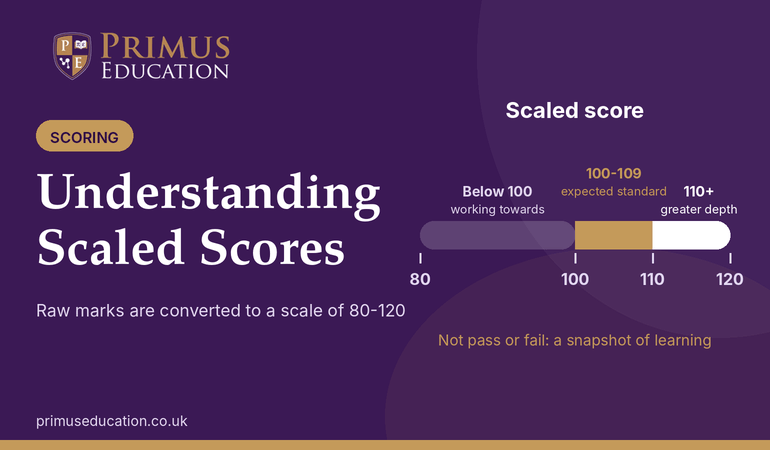
| Scaled Score | Meaning |
| Below 100 | Working towards the expected standard |
| 100–109 | Met the expected standard |
| 110–120 | Working at greater depth (higher standard) |
The actual marks needed to get 100 can vary slightly each year, as the papers are not always the same difficulty. This is normal and does not mean the test is testing something different.
This is why parents should look at a child’s understanding and progress, not the raw marks from different years.
How KS2 SATs Affect Secondary School
Good SAT results help, but don’t dictate which secondary school a child attends.
Places are allocated through the local admissions process according to criteria such as catchment area, sibling priority or, where applicable, grammar school entrance tests. SATs results could guide the set or group a child starts in and whether Year 7 teachers offer extra support or challenge.
The main aim of KS2 SATs is to assess academic attainment and to help schools plan the next stage of learning.
What If My Child Misses a Test?
If your child is unwell or unable to sit a paper for a genuine reason, please inform the school as soon as possible.
Schools can usually seek special consideration and, in some cases, an approved timetable variation allowing a pupil to sit a missed test within the allowable time.
Whether it is possible depends on the circumstances and on the relevant assessment rules. If you give notice, options are easier to arrange, so let the school know as soon as you can.
Common KS2 SATs Myths and Misconceptions
There are lots of questions parents have about the SAT, and some myths can create unnecessary pressure on children. Let’s clear up a few of them.
Myth 1: SATs are a pass/fail test.
Fact: They aren’t. There is no certificate, no fail letter. The results indicate whether a child has met the expected standard.
Myth 2: Secondary school admissions are based on SATs results.
Fact: SAT scores do not count toward admissions. Places are awarded via the local admissions process.
Myth 3: One SAT score is a measure of a child’s ability.
Fact: SATs are a snapshot of learning in specific subjects at a specific point in time. They can’t measure all aspects of a child’s intelligence, creativity or potential. Children can be good at many things that are not tested on.
Myth 4: Low scores don’t mean a child won’t succeed in secondary school.
Fact: A week of testing is a snapshot. Every child develops at a different pace, but with the right teaching, extra support, tuition and regular practice, pupils can catch up and thrive.
Myth 5: Preparing for the SATs is all about memorising answers.
Fact: Effective preparation is learning concepts, learning how to solve problems, and learning how to apply knowledge to different questions.
Myth 6: SATs aren’t required.
Fact: In state-maintained primary schools, they are statutory.
Why It Is Important to Prepare
SATs are not a judgement, but preparing well has real advantages for your child, far beyond the tests themselves:
- Builds a solid foundation: Reviewing key topics in English and maths develops the skills essential for secondary school.
- Builds confidence: Knowing the format and question types reduces anxiety and allows children to demonstrate what they can really do.
- Teaches time management: The papers are timed, so practising them helps children learn time management and pacing, a skill they will use throughout school.
- Highlights strengths and weaknesses: Targeted practice points to where to focus and closes learning gaps.
- Encourages a positive attitude to learning: Steady work toward a goal builds discipline and perseverance.
- Supports the move to Year 7: Good results can help secondary schools place pupils appropriately and offer extra challenge or support where needed.
How to Prepare for the Year 6 SATs
Many children start some light preparation in Year 5 and more focused practice in Year 6. Starting early instils confidence, without pressure.
English
Read a lot of fiction and non-fiction books. The paper has a range of text types and tests the ability to infer meaning, not just recall facts. Discussing characters, events, and key details of stories helps with comprehension.
If you are trying to write, short, regular practice with sentence structure and punctuation is better than infrequent, long sessions.
For grammar, go back over basic rules (verb tenses, punctuation, sentence types) in small pieces rather than cramming. And it’s worth learning new vocabulary and spelling patterns regularly.
Maths
First, get good at the basics – arithmetic, times tables, and fractions – and develop speed and accuracy. Then practise using those skills on worded, real-life style problems, which is where a lot of pupils lose marks, even when their core maths is solid.
Don’t leave questions about shape, measurement and data until last; they’ll always come up. Children should also be practising explaining how they got an answer, not just learning calculation methods.
A relaxed way to practise is to engage in everyday activities like cooking, shopping, and reasoning games.
Developing Time Management Skills
KS2 SATs are timed tests, so children need to learn how to manage their time well. Parents and tutors can help children by:
- Doing exercises within reasonable time limits.
- Learning to spot the easier questions first.
- Not spending too much time on one difficult question.
- Checking answers if time permits.
- Learning how long each paper is and what structure it has.
Regular practice helps children become more at ease working under examination time constraints
Should Children Practise with Past Papers?
Yes, and it’s one of the most useful things a parent can do. Past papers help children get used to the real question formats and wording, build timing under pressure, and show clearly which topics need more work. Some particular benefits include:
- Learning question formats: Children learn the way questions are asked and presented.
- Identifying weak areas: Practice papers help to highlight topics that need further revision.
- Improving time management: Children can work on completing questions in the given time.
- Building confidence: Knowing the exam format can make the real exams seem less daunting.
- Track Progress: Parents and teachers can see how well the child is doing across multiple practice sessions.
But past papers should not be a substitute for proper learning and understanding.
Children should first build up their subject knowledge before attempting full practice papers.
Do not make every practice session a timed test. Do not use papers from years when the format has changed since then.
Instead of finishing a full paper every day, focus on going over mistakes and understanding why certain answers were wrong.
A Simple Revision Timeline
A structured revision plan can help children prepare without feeling overwhelmed. Here is a simple timeline parents can follow:
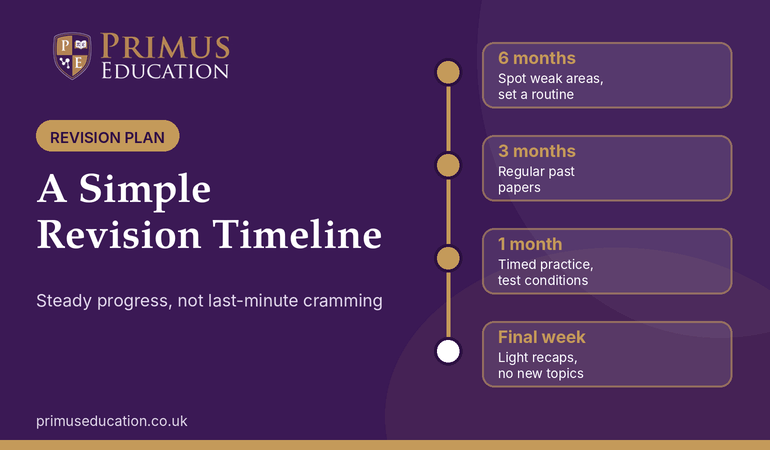
| Timing | Recommended Activities |
| Around six months before | Identify weak spots with the teacher’s help and give them the most attention. Review core topics and establish a consistent routine. |
| Around three months before | Start working through past papers regularly, one subject at a time. |
| About a month before | Move to timed practice under test-like conditions so the format feels familiar. Review common mistakes. |
| Final week | Keep it light with short recaps and confidence-building only. No new topics. |
The amount of preparation required will differ from child to child. Some pupils may require extra help in particular subjects, and some may require occasional revision and practice.
The aim should always be to make steady progress, not to put yourself under undue pressure.
How Parents Can Support Their Child
You don’t have to be an expert in everything. A peaceful, supportive home can help build confidence and reduce anxiety. For more ideas, see our guide on how parents can support their child with the 11+ and SATs.
- Make a study schedule, but keep it flexible so it doesn’t become another stressor. Use short, focused sessions: 25 to 30 minutes of work, followed by a break, works better than long, unbroken stretches.
- Keep reading each day all the way up to test week. Shared reading and discussion of stories can enhance comprehension and vocabulary.
- Make maths practical: Use everyday examples involving money, measurements, time and numbers to consolidate mathematical understanding.
- Talk about mistakes positively: Focus on what children got wrong, not just wrong answers.
- Reward effort and improvement, not just outcomes. And praise the progress. Encourage the children to continue to practise.
- Protect sleep: screen-free wind-down in the hour before bed.
- Serve slowly releasing snacks like fruit and nuts rather than sugary snacks.
- Keep exercise during the week and outside working time.
- Speak with your teachers: Ask how your child is doing and which subjects might benefit from more help.
A calm and supportive environment can help children take a more positive approach to SATs preparation.
Common Mistakes Parents Should Avoid
Parents play an important role in supporting their children through SAT preparation. But well-meaning approaches can create unnecessary pressure. Here are some traps to avoid:
- Comparing your child with siblings or classmates: Every child learns differently. Comparisons rarely motivate and often create pressure or erode confidence.
- Last-minute cramming: Regular preparation is usually more effective than last-minute cramming before tests. Better an anxious one than a relaxed one last week.
- Pressure overload: Children are more sensitive to parental anxiety than we think. It’s very easy to get fixated on the marks you get on exams – but this can be detrimental. You need to understand the concepts, have good learning habits, and do well on tests.
- Ignore the weaker subjects: Instead of repeating what they already understand, children should be helped with the subjects they struggle with.
- Skipping normal reading
- Sleep matters: tired pupils perform worse, no matter how much they have revised. Rest is crucial for concentration, memory and general well-being.
How Tutoring Can Help
Every child learns differently. Some pupils may be confident in English but need more practice in maths; others may need help with reading comprehension, grammar or exam techniques.
Structured tutoring can be a big help, especially for kids who feel unsure or need extra practice. A good tutor can:
- Explain concepts clearly and concentrate on areas where each pupil needs more attention rather than simply memorising answers.
- Teach exam techniques including time management and careful reading.
- Offer past papers and mock tests. Personalised practice in weak areas.
- Instil confidence, reduce test anxiety and foster independent learning skills in children.
The aim is for a child who feels able and ready for Year 7, not one who is stressed about scores.
SATs Week Checklist
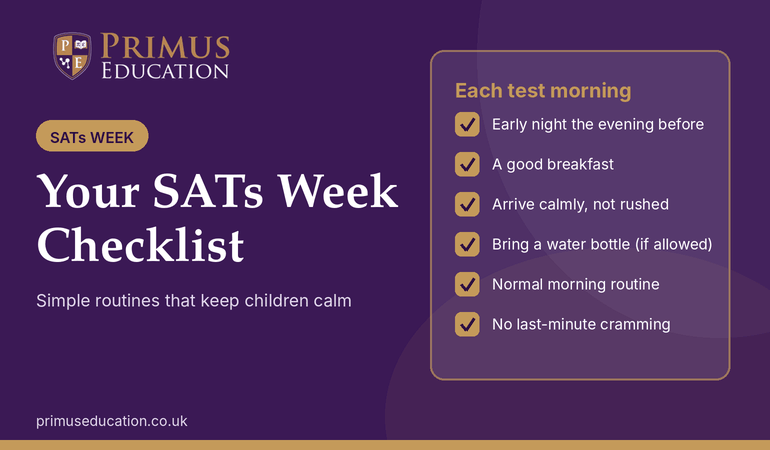
A simple routine can help children feel more relaxed in SATs week. Parents should encourage their child the morning of each test to:
- Have a good night’s sleep (an early night the evening before).
- Eat a nice breakfast.
- Don’t rush to come to school on time.
- If the school allows it, bring a water bottle.
- Do their normal morning thing.
- Remain calm and don’t cram at the last minute.
Encourage your child to take their time, read each question carefully and do their best.
Final thoughts:
KS2 SATs are important, but they’re just one part of a much longer educational journey, and not a verdict on your child’s ability or potential. They don’t decide their intelligence, their potential, or their future success.
Helping kids know what the exam will look like and preparing a solid foundation in English and maths, along with regular practice and a positive attitude, can help children approach SATs with more confidence.
The best thing is to stay calm, revise steadily, avoid cramming at the last minute, and use the results as the starting point for the next stage.
Parents can play an important role in encouraging their children to develop a good revision routine and provide additional help if needed.
At Primus Education, we believe every child deserves the chance to build their academic skills and confidence in learning.
We run a Key Stage 2 SATs program for Year 6 students across Manchester.
It provides structured tuition in English and maths, as well as practice papers, mock exams and one-to-one support where it’s needed most. We help pupils consolidate knowledge, develop examination techniques and prepare for transition to secondary school.
If you’re wondering if tutoring is worth the cost, our guide to private maths tutor costs explains what you can expect, and if you are considering grammar school entry as well as SATs, then our 11+ entrance exams guide is well worth a look.
To learn more about how we can help your child’s academic progress, contact Primus Education today.
Frequently Asked Questions
What is covered in KS2 SATs?
English reading, English grammar, punctuation & spelling, maths (arithmetic and reasoning). Writing and science are teacher-assessed, with optional science sampling tests in some schools.
Are KS2 SATs compulsory?
Yes. They are statutory assessments of eligible pupils in state-funded schools in England. Depending on the circumstances of the pupil (e.g., significant SEN or medical needs), certain exceptions and alternative arrangements may apply, and these will be agreed with the school.
When are KS2 SATs?
SATs for KS2 are usually held over four consecutive school days in May. The official timetable is published annually by the Standards and Testing Agency.
How are SATs marked in KS2?
Pupils are awarded scaled scores between 80 and 120. For the expected standard to be met, the relevant test score is 100 or above.
Is there an official pass mark?
There is no pass or fail; a scaled score of 100 or more indicates that a child has met the expected standard for their age. An elevated standard is a score of 110 and over. However, results should be interpreted in terms of the child’s overall academic development.
When should my child begin to prepare?
In Years 5 and 6, children can build on their knowledge and confidence. Year 5 can be light preparation, and then Year 6 can be more focused revision. Pace it out using the revision timeline above.
Can my child retake KS2 SATs?
No. There is no formal opportunity to resit for pupils who have taken tests and received results. If a child is not meeting the expected standard, then the focus is on targeted support in secondary school. Approved timetable variations may allow certain pupils who miss a test to take it later, in accordance with the relevant rules.
Do SATs results affect secondary school admissions?
No. Places are allocated via the local admissions process. Results can influence which class groups a child enters when they start but not which school provides a place. SAT results can help secondary schools identify their pupils’ academic needs.
What percentage of pupils meet the expected standard?
It varies from year to year. In 2023, 61% of pupils in England reached the expected standard in reading, writing and maths combined, a small increase on the previous year but down on the 65% recorded in 2019. The latest figures are available in the GOV. UK publication.UK publication.
Can parents withdraw their child from SATs?
Not usually. Withdrawal is only considered in limited circumstances, such as significant SEN or medical needs, and is agreed with the school.
Are past SATs papers useful for preparation?
Yeah. Past papers are useful for children to get used to the question format, practise time management, and identify areas that need improvement. They are most effective when used alongside regular teaching and subject-specific revision.
How can parents support preparation at home?
Encourage regular reading, short daily maths practice, positive conversations about mistakes and a healthy routine of sleep, exercise and breaks. It is also important to keep a calm environment and allow time for rest.
Can tutoring help children prepare for KS2 SATs?
Yes. Structured tuition can provide children with additional help with subjects they struggle with, through personal explanations and more practice. It can also help pupils build examination techniques and confidence.